What Is the Difference Between Agarwood Oil and Oud Oil?
By William Wong · Updated October 6, 2026
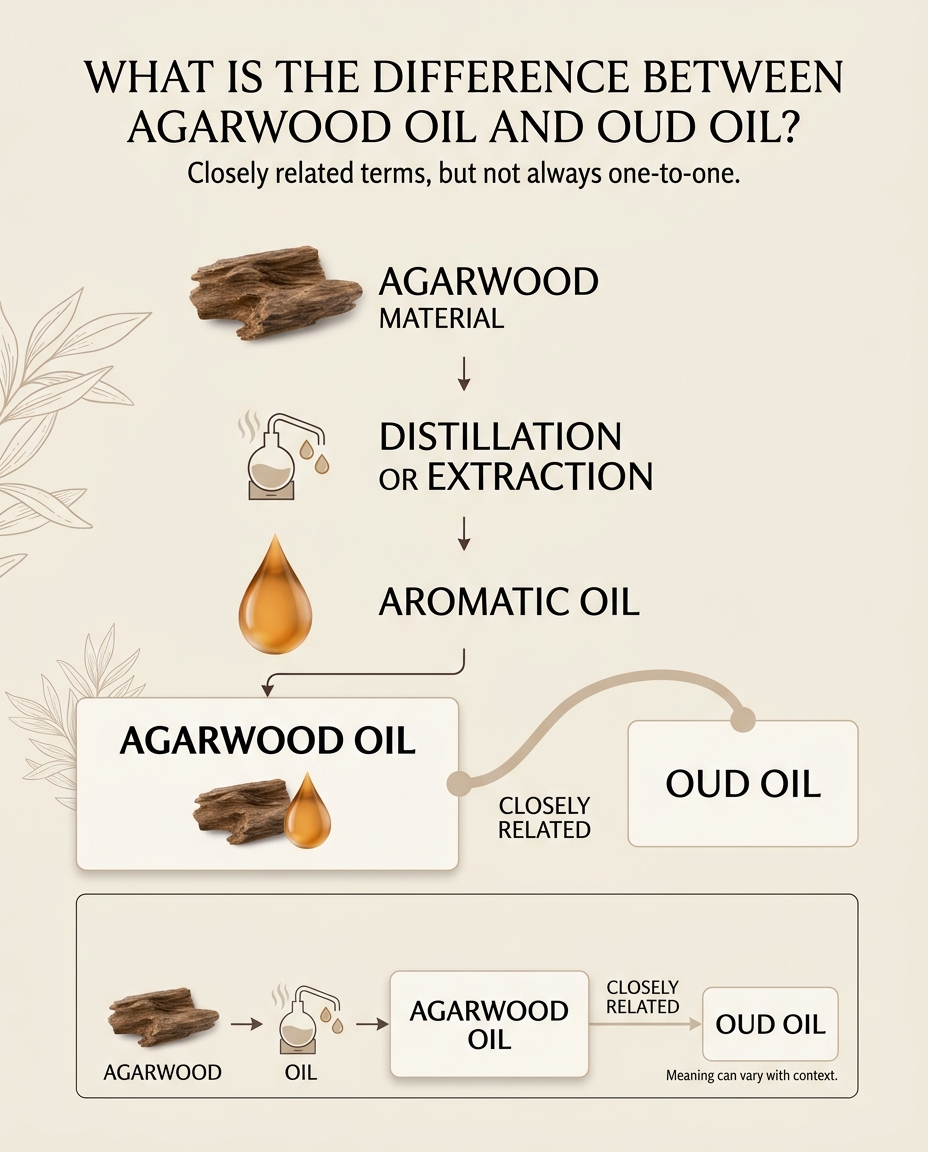
The easiest way to understand the relationship is to start with the material itself: agarwood is the fragrant resinous wood, while oil is a processed aromatic product obtained from that material. “Oud oil” is a closely related term widely encountered in fragrance and aromatic contexts.
Agarwood is the material; agarwood oil is an oil obtained from that material. “Oud oil” is a closely related term whose usage can vary with context and industry.
The Basic Relationship
From Agarwood to Oil
AgarwoodFragrant resinous wood produced in certain Aquilaria and related trees.
↓
Distillation / ExtractionProcessing can obtain aromatic oil from plant material, including agarwood.
↓
Aromatic OilThe resulting oil contains aromatic compounds from the processed material.
↓
Agarwood OilOil obtained from fragrant agarwood material.
Agarwood oil is therefore a material-to-product relationship: the fragrant resinous wood is the starting material, and the oil is a processed aromatic product.
What Does “Oud Oil” Mean?
“Oud oil” is a closely related term used widely in fragrance, perfumery, incense, and other aromatic contexts. In some contexts it refers to oil associated directly with agarwood; in others, the exact meaning of the term depends on the market, product, or industry context.
For that reason, the name “oud oil” by itself should not be treated as a complete technical definition of the oil’s material source or composition.
Compare the Terms
Agarwood Oil
A term that describes oil obtained from fragrant agarwood material, commonly through distillation or related extraction processes.
Oud Oil
A closely related term widely used in fragrance and aromatic contexts. Its precise usage can vary with context and industry.
Why Are the Terms Used Together?
Agarwood has long been an aromatic material used in fragrance and perfumery, and “oud” is a widely encountered name associated with agarwood in these contexts. Modern product language can therefore bring the two terms together, especially when discussing aromatic oils.
Are They Always Exactly the Same?
Not necessarily as a matter of terminology. “Agarwood oil” points more directly to oil obtained from agarwood material, while “oud oil” is a closely related term whose meaning and usage can vary by context and industry. The two should not be treated as either completely unrelated or as a guaranteed one-to-one translation.
What Can Affect the Character of the Oil?
The character of an agarwood-derived oil can be influenced by the source material, tree and species differences, region and growing conditions, how the resin developed, and the processing or distillation conditions. This is one reason agarwood oils can show substantial differences in aroma and composition.
The simple way to think about it
Agarwood is the fragrant resinous material.
Agarwood oil is oil obtained from that material.
Oud oil is a closely related term used in fragrance and aromatic contexts.
The relationship is close, but the terminology is not always a strict one-to-one definition.